Are you a mindful eater?

0010385539X-565x849

When most people talk about eating habits and diet, 9 times out of 10, they talk about what we should eat saying that such and such a food is  good for you while another food is bad for you. But it’s not just what we eat that matters, it’s how we eat as well and I don’t just mean should you eat three meals a day, two meals a day or even six meals a day. It’s the actual eating habits that we have that can make a huge impact not only on what we eat but how that food affects us as well.

Registered dietician, Amy Watson has done a very nice article that answers the question, “Are you a mindful eater” and I’m just going to quote one thing from her where she says “Being a mindful eater can lead to better digestion. If your mind isn’t focused on the meal, your digestive process may be 30 to 40 percent less effective. This can contribute to issues such as gas, bloating, and bowel irregularities.”

It then goes on to show us how we can become more mindful eaters and improve both our digestion and our health. See the link below.

Link to the article

Sweet poison: why sugar is ruining our health

foods-112127-m

Being a child of the 60s I grew up with everything being sweetened, with tons and tons of sugar. And of course in later life that didn’t do me any good.

Thankfully in my late 20s I realized what this was doing to my body and decided that the two spoonful of sugar in my tea and the two or three in coffee had to stop simply because when you add up how much sugar I was having each day, it was probably somewhere around 40 teaspoonfuls and that of course doesn’t include what was in the food that I was eating.

According to this article by Victoria Lambert, the average person consumes around about 238 teaspoons of this potentially toxic substance each and every week. And she asks the question; just how hard is it to go sugar-free? Well thankfully, she also answers it as well.

So do follow the link below and find out how you can get sugar-free or at least drastically cut down something that is probably ruining your health.

How to Break a Weight Loss Plateau

Break a Weight Loss Plateau

So many weeks in to your diet and you’ve been doing really well. Pounds are coming off, the inches are going and you are probably feeling quite pleased with yourself.

Then all of a sudden your daily weight in session is the same for two days running, and then three, and then four. Even though you’re exercising and you’re eating as you know you should do, nothing is moving in the scale front. You have reached what is known in the trade as a plateau.

Here’s a short but sweet article that will give you a few tips and tricks on how to deal with it.

You’re doing everything right. Counting calories and lifting weights and doing massive amounts of cardio. One day, you realize that you’ve stopped burning fat. No longer can you fit into smaller and smaller clothes; the scale is unchanged for days, perhaps weeks. How frustrating. You’ve hit a weight-loss plateau that can easily be broken.

Steps

  1. Trick your body. Change up your routine. If you’re hitting the exercise bike or the elliptical, do something different. If you are doing the same exercises over and over again, your body “knows” what to expect. It’s called “specificity of training”. If you work out at a gym, change your cardio routine by jumping on a stair-climber, a treadmill, or a rowing machine. Try ten minutes of intense cardio work on a machine and jump on another and repeat. Mix up your routine so it’s not a routine.
  2. Join a sport. An active sport is a great to change up your routine. Sports like racquetball, tennis and basketball will work different muscle groups with lateral movement instead of the same boring forward movement on a treadmill or elliptical (that’s not to say that the treadmill or elliptical aren’t good machines, but mix it up!). If you don’t have a gym membership and instead get your cardio by jogging, try riding a bike or swimming or some other such exercise. The key is to try something new to “trick” your body into losing weight.
  3. Weight train. The more muscle mass you have the more calories your body will need to maintain it. This is very important and very effective. You may feel more hungry after a heavy lifting session; this is your body trying to supply the needed calories to increase the muscle mass (tips on how to deal with this later). Ladies, don’t be afraid to lift some heavy weight. There are plenty of girls at the gym who may look thin but are a bit soft in the flesh. This may make them want to do more cardio to burn the fat. This is a perfect reason to hit up some weights and tone up. Eat only the right type of carbohydrates. It’s important to have carbohydrates in your diet and life without them, as many of us experienced in the early 2000’s with the Atkin’s diet is a pain. What works is to eat “good carbohydrates.” Multi-grain bread is fine, but have no more than a couple of slices a day. The point is to stay away from refined sugars. These are found in pasta, white breads, cakes and other sweets and all the things we think we love. Even small amounts can kill your diet so it’s best to stay away from them in the first place. The good news is when you eliminate heavy sweets from your diet, it only takes a few days to not crave them anymore. They will appear unappealing because such a diet forces you to make healthy choices in the food you eat.
  4. Increase your protein intake. You have to supplement something for cutting your carbohydrates right? Protein is excellent. It promotes strong lean muscle tissue which is beneficial to fat burning. Protein fills you up better than a heavy carbohydrate meal. This is an added benefit to help cut your caloric intake.
  5. Eat six small meals a day. Eating small portions throughout the day will help keep your metabolism going. This is an extremely useful tactic in breaking your weight-loss plateau. Eat something when you wake up in the morning, perhaps a small omelet with cheese. And as you continue throughout the day, snack on  cheese or some other natural, unprocessed food. Pretty much keep your meal times as normal; breakfast, lunch and dinner with a meal in between each and something for the evening. It’s not that important to count your calories, but try to be a scientist and find out what works best for you. What can you eat that is small and will curb your hunger for the next 2 and a half hours before your next small meal? Keep it higher in protein, small in calories, and nutritious. 
    • If you must count calories then aim to eat a consistent amount of calories, and track your caloric intake regularly. Many diets fail from overindulging, which is brought on by an overly restrictive diet plan. Instead, aim for a consistent caloric intake that will allow you to fit in indulgences as needed. This way, you can enjoy eating while still achieving your weight loss goals.
  6. Change your long cardio session to shorter more intense interval training. Conventional myth states you have to participate in a certain “fat burning” zone in order to lose body fat. Stale, long, boring cardio is actually keeping people stuck in their plateaus. Instead, favor sprint interval training to set a new challenge to the body. Making this change will reinvigorate the adaption response. Initiate the intervals by incorporating one-minute bursts of intense activity then return to a normal pace for one to two minutes. Research has shown you will significantly raise your heart rate during and for up to 6-9 hours after the workout, thus burning more calories during and post exercise.

Tips

  • Keep hydrated. Water is good for you; it cleanses your body of toxins and will make you less hungry throughout the day. Stay away from sports drinks; they’re just empty calories.
  • Getting 8 hours of sleep and limiting stress is a sure fire way to reinitialize the weight loss process.
  • Keep your exercising consistent, meaning don’t skip out on workouts. Be committed to your weight-loss by lifting every other day and doing cardio at least 5 times a week, even more if you really want results.
  • Do your resistance training before your cardio. You’ll use up your glycogen stores doing the weight training and when you move on to cardio, your body will use your fat stores as a fuel source.

Warnings

  • Be careful to have a mixture of healthy foods. Change up your fruits and vegetables. Learn how to cook healthy meals that are higher in protein and lower in carbohydrates. It’s important to get all the nutrients you need.

Article provided by wikiHow, a wiki how-to manual. Please edit this article and find author credits at the original wikiHow article on How to Break a Weight Loss Plateau. All content on wikiHow can be shared under a Creative Commons license.

Fat Feeds Leukemia Cells According to Researchers at Children’s Hospital Los Angeles

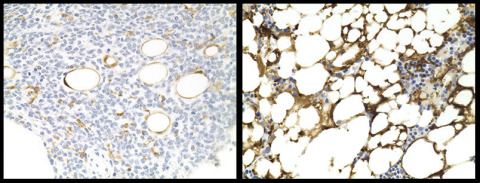
Bone marrow from a child with leukemia before (left) and after (right) chemotherapy. Chemotherapy causes an increase in the number and size of the fat cells in the marrow (white ovals). These fat cells have a large amount of an enzyme (glutamine synthetase, which shows up as brown in this picture), allowing them to produce glutamine and potentially feed nearby leukemia cells. (Photo: Business Wire)


Not many people realize that apart from the physical problems, being overweight can make you more likely to suffer from ther far-reaching health problems.

Now if you as an overweight person visits your physician or doctor, they are much more likely to talk about how being overweight is bad for your heart than anything else. What they won’t tell you, maybe that’s because it’s not something widely broadcast even in the medical profession, is that being overweight means that you are more likely to suffer with cancer.

The thing is I suppose if you have a heart problem due to being overweight, well you can lose the weight and for most people their heart problems will also disappear as the weight drops off. Unfortunately that is not the same with cancer.

Here’s a fairly technical article, I must admit, from the Los Angeles Children’s’ Hospital. It should be noted, I have got quite a reputation for investigating cancers particularly as you might have guessed, in children. Not only do they have statistics to show that obese people are more likely to have cancer than lean people, they have taken their research as stage further and up to a certain point of proving that this is true.

Follow the link below to find out more.

Link to article

Recognizing the Dangers of Artificial Sugars

You are likely the same as most people today in that you’re conscious of your weight and your health. You may be trying to find a way to reduce or eliminate the sugar in your diet. It is tempting to do what many others do and just replace sugar with artificial sweeteners. However, it is important for you to recognize the dangers of artificial sugars.

sweetener-artifical-sugar-5369702-hAlthough these artificial sugar substitutes have been in use for many years, it is vital that you take a close look at recent research to see if they are safe enough for you to use on a regular basis. Of course, you realize that consuming too much sugar is not good for you either. Therefore, it is important to weigh all the pros and cons in order to make informed and educated choices.

It has become a common trend to substitute unhealthy foods with alternative “light” versions. These are designed to deliver a similar taste and mouth feel as the food we are replacing without having the same harmful effects on our health. However, we need to exercise caution that these artificial substitutes – which are not real foods like the ones we are attempting to replace – do not cause us more harm than good.

Saccharin is a popular artificial sugar that has been around for over 100 years. This is the sweetener you are familiar with as Sweet’N’Low in the pink packet.

Aspartame is an artificial sweetener that became popular around 30 years ago, and it is usually in a blue packet. You will likely equate this with the brand name Equal.

Sucralose is the most recent addition to the artificial sugar list. It is often presented in a yellow packet and goes by the brand name Splenda.

All of these artificial sugars create a metabolic response in your body the same as if you had eaten regular sugar. You are eating something sweet, and so your brain gets confused and thinks you have actually eaten sugar.

When no actual calories come pouring into the blood stream, your brain tells your body to find some food because it was expecting it. Because of this reaction, you are more likely to increase your appetite and your desire for sweets by continuing to sweeten your food and drinks with artificial sugars.

Also, the very nature of the fact that these substances are artificial makes them difficult for your body to metabolize. You are essentially putting chemicals into your system, and your body has a hard time digesting and using these unnatural substances that you are consuming.

headache

Artificial sweeteners have been linked to various troubling medical conditions. There are some studies that show there could be a connection between the use of these artificial sugars and various illnesses, including headaches, joint pain, kidney or liver problems and possibly even the development of tumors.

You need to make responsible and informed decisions about what you put into your body. Learning about the effects of on your body and the potential health risks can aid you in recognizing the dangers of artificial sugars.